Making our AI Scientist a collaborative co-worker. The New UX of Potato
By Ansel Santosa , Principal Engineer
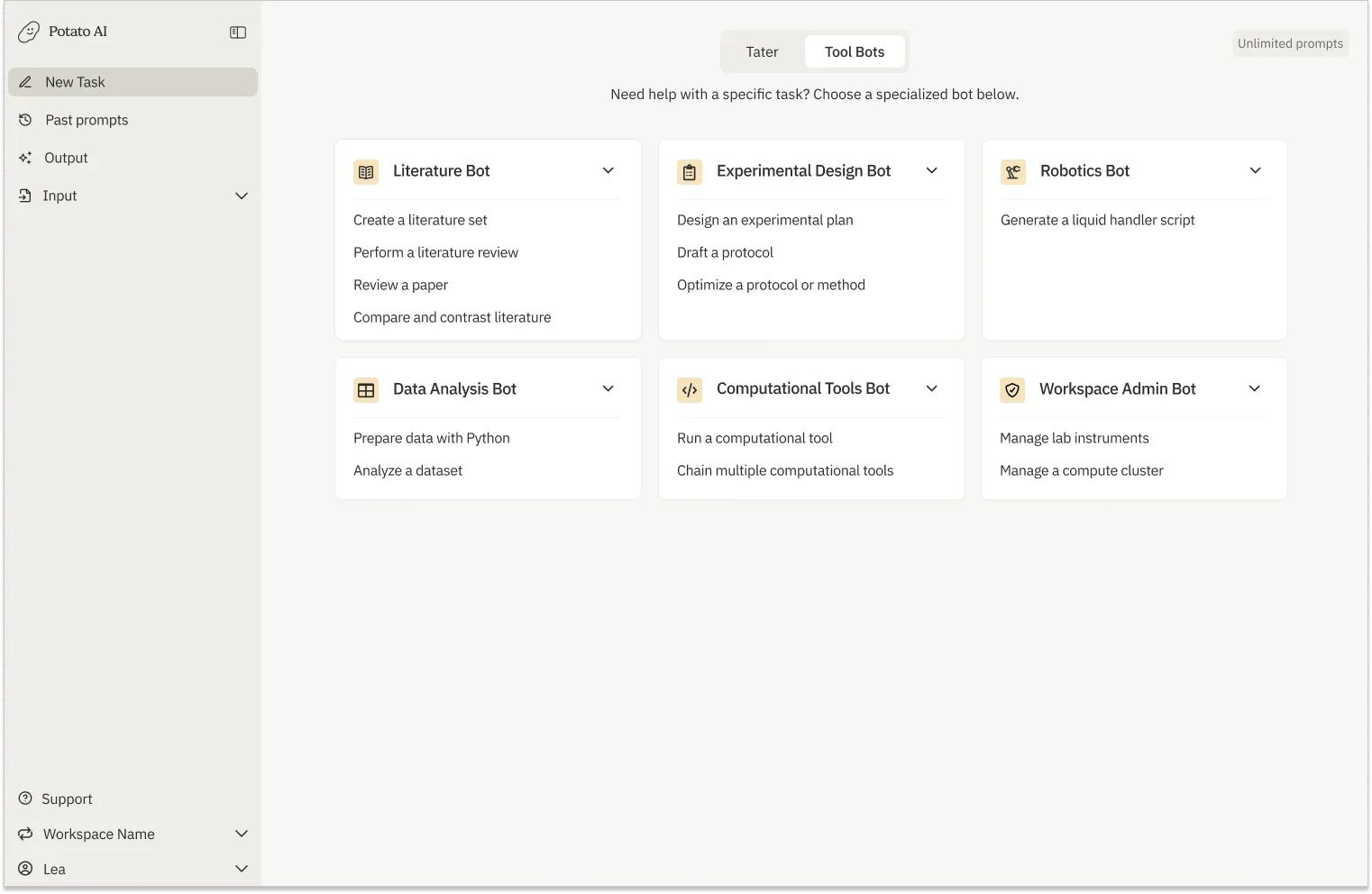
Today, we are launching Potato 2.0. We restructured the platform to make features more discoverable, applied a consistent design system for improved usability, reorganized our tools to better reflect users' mental models and much more. We are also working towards a new conversational UI that will enable users to invoke bots and tools within prompts and more. Finally, we have a new color palette that represents the playfulness and magic of Potato.
Potato does science, but nobody wants a genius for a co-worker if they're difficult to collaborate with. That's where UX comes in. An AI scientist must master many difficult tasks: solve for the stochasticity of AI systems, satisfy expectations for academic rigor, and deeply understand the scientific process. Crucially, it must also clearly expose its reasoning, deliverables, process, and task list in a way that is easy for co-workers to understand.
User Centered Product Development
We utilize a variety of tools and UX Research methods to inform the design and development of Potato.
- Interviews: Our UX Researcher runs usability studies and interviews with experienced, novice, and new Potato users. These expert-run sessions, utilizing interactive, clickable prototypes, help us quickly test hypotheses and iterate throughout the design process.
- Observation: We observe how users interact with the product to understand where they hesitate, get stuck, and which workflows create the most friction.
- Internal Feedback: Many people at Potato spent years as working scientists before joining the company, so product decisions are constantly informed by people who understand both the science and the software.
- Other UX Research methods: Card sorting to discover intuitive groupings of features, heuristic evaluations to determine pain-points, and cognitive walk-throughs to validate assumptions with users before the prototyping phase.
Platform Reorganization
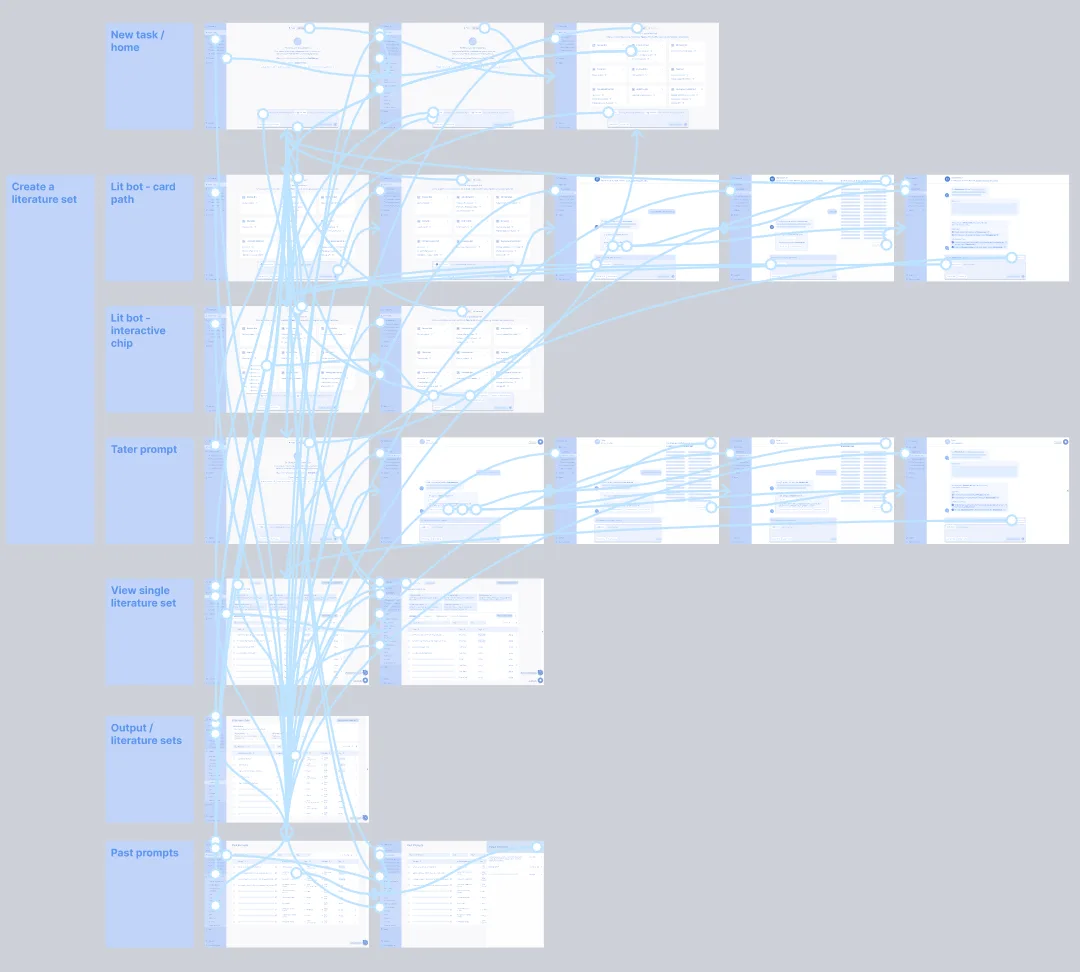
As our capabilities grew, our platform also needed to evolve. Output generated from user prompts and the tools used to fulfill them, such as protocols, computational workflows, paper reviews, document comparisons and many others, were becoming difficult to locate within the platform.
We approached this problem by reorganizing the platform into three broad, top-level categories:
- Inputs: User-uploaded scientific content and resources, including the Papers, Data, and Liquid Handler Configuration that are some of the building blocks for analysis, experimentation, and workflows executed by Potato's tools.
- Outputs: Potato-produced content, including Research Plans, Literature Reviews, Robotics Scripts and Analysis Notebooks. These may serve as final deliverables or intermediate artifacts used by other Potato tools as a project progresses through the scientific process.
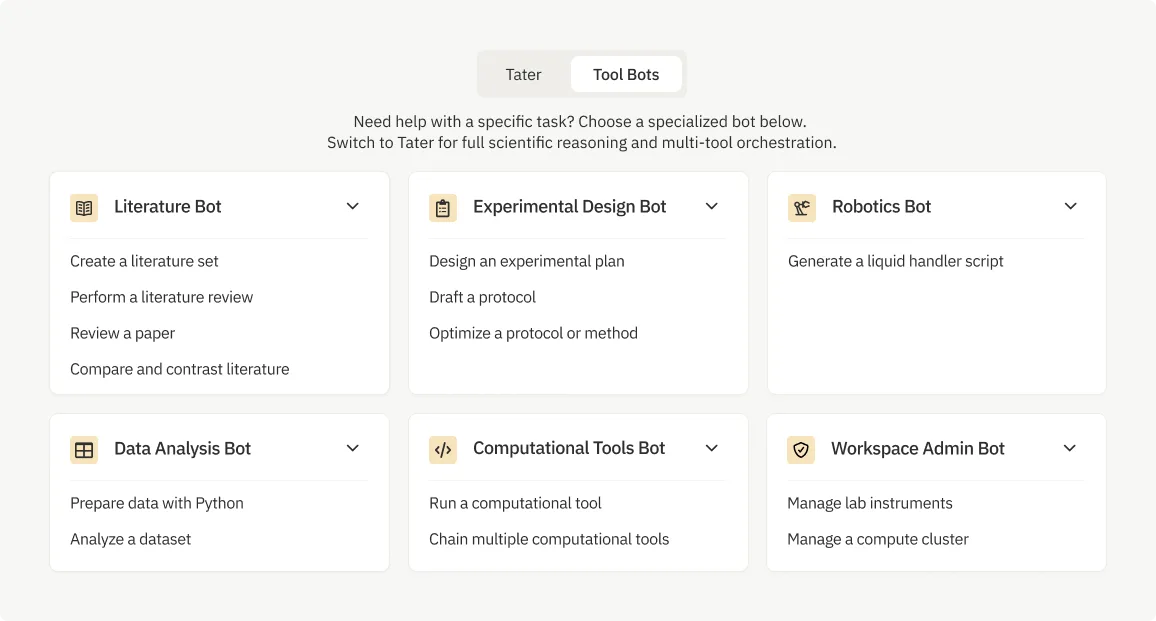
- Tools: The core platform capabilities are organized by common scientific research steps: Literature, Experimental Design, Robotics, Data Analysis, and Computational Tools.
This simplified system ensures that tools and output are easily discoverable and manageable, accelerating the scientific process for users.
How to Make an Expert User
My favorite research paper in the field of Human-Computer Interaction is "Becoming a Bartender: The Role of External Memory Cues in a Work-Directed Educational Activity" 1 . The author, (appropriately named) King Beach, discusses the importance of external visual cues in a user's journey toward expertise. In that study, bartending students were observed using bar layout and glass shapes to help memorize drinks and orders. Similarly, our users become experts on the Potato platform through referencing the consistent use of icons, color, and other design patterns. This helps them understand the system and its capabilities so that they can more efficiently incorporate Potato into their workflows.
Invoking Bots and Tools
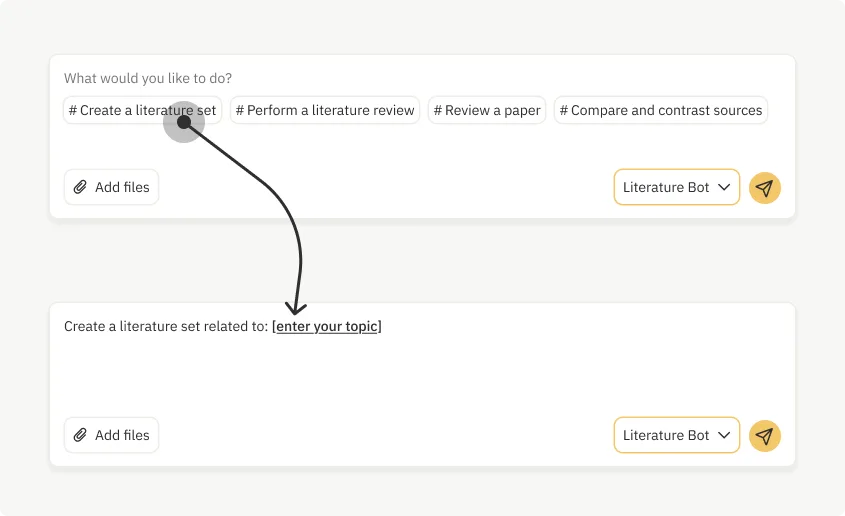
The beauty and the curse of an AI prompt is its flexibility and open-endedness. An expert knows exactly what to write to get their desired result, but a novice may not know how to frame their prompt. We help experts operate efficiently while simultaneously showing novices the ropes by enabling users to invoke bots and tools within their prompts.
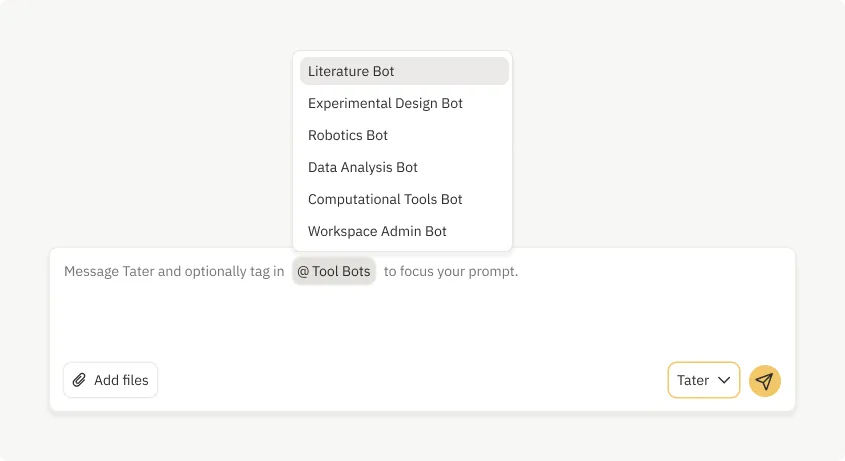
This structure, now in development, will allow users to @tag to switch between bots, specify tools they want to use and link to specific files to focus their prompts. We also support prompt templates that users can leverage to get prompts going more quickly — these are editable and serve as handy shortcuts.
From here to there
The next major step is converting all tools' experiences to conversational interfaces to drive collaboration between users and our tool bots. This is not a cosmetic update; it represents a fundamentally different way of interacting with Potato and requires significant front-end and back-end work. This standardized conversational model will help set expectations that users are interacting with collaborative natural language AI agents. It will simplify complex workflows through progressive disclosure; Potato can start with an overall goal and incrementally ask follow-up questions to reduce the cognitive load. It will enable iterative refinement as conversations are non-linear and mirror the scientific process of exploration, inquiry, and clarification of objectives.
We are confident in our evolution of product strategy, excited to begin this work, and look forward to hearing what our users have to say each step of the way. Our goal is to build a platform that is powerful yet easy to use. With the redesign of our platform, we're hoping to empower users to collaborate more effectively with Potato to accelerate scientific discovery.
References
1Beach, K. (1993), Becoming a bartender: The role of external memory cues in a work-directed educational activity. Appl. Cognit. Psychol., 7: 191-204. https://doi.org/10.1002/acp.2350070304
Ready to experience the future of science?
Request Early AccessLatest News & Press See all
R&D World: AI co-scientist startup CTO on ‘hypothesis slop,’ deterministic code and the goal of compressing a century of science into a decade
Blog Post: Making our AI Scientist a collaborative co-worker. The New UX of Potato
Wiley: The essential ingredient in AI lab tools: Peer-reviewed, validated science
Pharmaceutical Technology: Researchers become scientific tastemakers by handing more R&D to autonomous labs
Drug Discovery Today: AI agents in drug discovery: applications and case studies
For press questions, contact: press@potato.ai